
Emotional Support After the Death of a Child

Bereavement
Therapy
A safe, compassionate space to talk without a time limit on grief.
After your child dies, there is no right way to grieve and no point by which you should be “feeling better”. Bereavement therapy can give you space to speak honestly, explore what you are carrying and receive support that is focused on you.
What can bereavement therapy offer?
Therapy cannot change what has happened.
It can provide a consistent space where you do not have to protect anyone else from how you feel.

Space
to talk
A private place to speak openly about your child, your grief and whatever feels most difficult that week.

Support without judgement
Your grief does not need to follow a particular pattern, timetable or set of stages.

Led by
your needs
Support can focus on what matters to you and continue for as long as it remains helpful.
Support centred around you.
Why bereavement therapy?

There is no timetable for grieving your child.
The death of your child can affect every part of your life—your relationships, identity, routines, memories and sense of the future. Sometimes the people around you may not know what to say, or you may feel pressure to appear as though you are coping.
Therapy offers protected time to talk about your child and your experience without needing to make anyone else feel comfortable. You can bring the feelings, questions and memories that are difficult to hold alone.
You can need this support soon after your child dies, many years later, or around an anniversary or change in your life. Asking for help is not a sign that you are grieving incorrectly. It is one way of caring for yourself while carrying an extraordinary loss.
You do not have to carry everything alone.
Who can access bereavement therapy?
Our bereavement support is inclusive
Ripples supports parents and carers following the death of a child.
This includes miscarriage, stillbirth, the death of a baby or child, and the death of an adult child.
♡ There is no requirement for your child to have died from cancer.
♡ There is no time limit on when grief support may be needed. You can access it immediately after your child has died or years later.
♡ All support funded by Ripples is free to families
How requests are prioritised
We do not exclude bereaved parents from our therapy service.
However, as a small charity with a limited number of funded spaces, we may need to prioritise requests, including:
♡ Parents who have exhausted other available therapy provision
♡ Parents of children affected by cancer
♡ Families where the child’s death was more recent
♡ Parents of children who were under 18
These priorities help us make difficult decisions when demand is greater than the support we can fund. They do not suggest that one family’s grief matters more than another’s.
A gentle way to check how therapy is helping

We ask parents receiving bereavement therapy to complete a wellbeing questionnaire at different points during their support.
It is not a test, and there are no right or wrong answers. It is a chance to pause and reflect on how you are managing, what feels most important to you and where you may need more support.
Grief is personal and does not follow a straight line. Your answers may change from one questionnaire to the next, and that is completely understandable.
What does it ask about?
The questionnaire looks at nine areas of life. For each one, you are asked how you feel you are managing and how important that area is to you. There is also space to add more detail if you wish, but this is optional.
Looking after yourself
Managing practicalities
Children
Emotional wellbeing
Doing what matters
Continuing bonds
Relationships
Work
Trust and hope
When will I be asked to complete it?
Completing the same questions at key points helps you and your therapist notice changes over time.
1. At referral
To understand how things feel when you first ask for support.
2. When therapy starts
To provide a clear starting point for your work together.
3. During therapy
Every 4–12 weeks, depending on the length and pattern of your support.
4. When therapy ends
To reflect on any changes and the difference your support has made.
Keeping support helpful
Your answers help you and your therapist consider whether therapy continues to feel helpful and where your sessions may need to focus.
Understanding change
Looking at the measure over time helps us understand the difference therapy may be making, while recognising that grief can change from day to day.
Keeping therapy free
Anonymised information helps us show funders the impact of this support, so we can continue providing bereavement therapy free of charge to parents.
Your information is treated with care
Your completed questionnaires are handled confidentially.
When we use the results to explain the impact of our service to funders, the information is anonymised so that individual parents are not identified.
Your scores do not affect whether you are eligible for support.
“I just wanted to email you to thank you for the wonderful counselling I have had this past year which has now come to a close.
My weekly counselling sessions have really had such a huge impact on me and helped me so very much with my grief.
To have that space, just for myself, to enable me to have someone to talk to 1-1 has been amazing. Thank you all so very much for all you do for us bereaved parents.”
— Parent

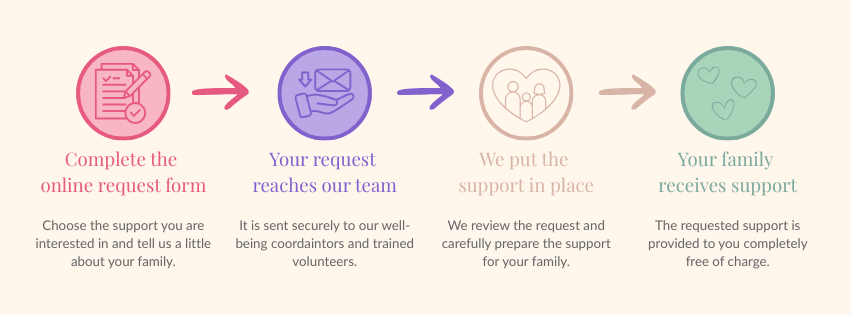
How to request support
Need urgent help?
Ripples’ bereavement therapy is not an emergency or crisis service. If you or someone else is in immediate danger, call 999 or go to A&E. You can also call Samaritans free at any time on 116 123
Samaritans
Help keep therapy free
Give a family space to be heard
A donation of £60 can help give one bereavement therapy session to a bereaved parent or family.
Every family’s grief is different
❤️
Your grief does not have an expiry date. If you think bereavement therapy could give you somewhere safe to talk, we’d love to hear from you.